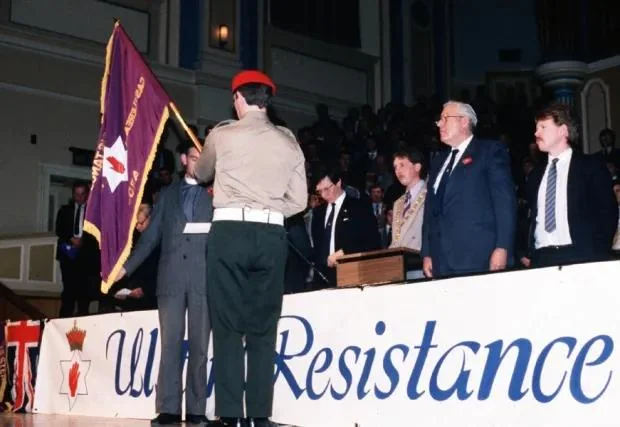
ULSTER RESISTANCE WAS PRECEDED BY A NUMBER OF ATTEMPTS AT FORMING PARAMILITARY ORGANISATIONS BY THE DUP
10th November 2026 marks the 40th Anniversary of the establishment of Ulster Resistance by the DUP.
Ulster Resistance was preceded by a number of attempts at forming paramilitary organisations by the DUP
In June 1976, senior DUP politician Peter Robinson approached another DUP politician, Clifford Smyth, secretary of the United Ulster Unionist Council, with a suggestion for a DUP paramilitary wing.
Smyth was then Intelligence Officer for the loyalist paramilitary grouping, Tara, sitting on its six-man “brigade staff”.
According to a senior Ulster Defence Association (UDA) figure Andy Tyrie, the paramilitary organisation was also contacted that year by a DUP member with a request for assistance in arming the DUP’s new group.
This earlier attempt at a militant DUP force never materialised, although the United Unionist Action Council (UUAC), a sub-committee of the United Ulster Unionist Council, of which the DUP was the leading political party, had a semi-paramilitary wing already in the Ulster Service Corps (USC). The UDA, Down Orange Welfare and the Orange Volunteers were also represented on the UUAC.
In 1981 the DUP established the Third Force to act as an armed Protestant volunteer, mostly made up of RUC and UDR personnel.
According to official Irish Governmental papers Ian Paisley approached the Israeli Ambassador to London Yahuda Avner in June 1985, before the signing of the Anglo-Irish looking Israel to supply arms to him.
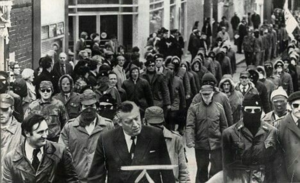
THE FORMATION OF ULSTER RESISTANCE
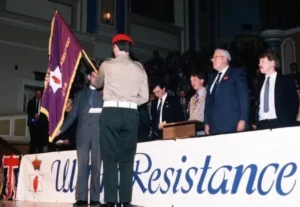
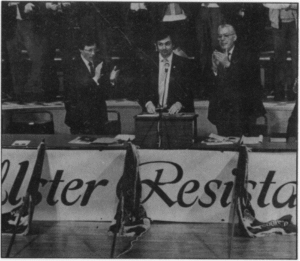
Ulster Resistance was launched at a 3000- strong invitation-only & male-only meeting in the Ulster Hall Belfast on the 10th November 1986.
The rally was chaired by DUP Mayor of Belfast Sammy Wilson and addressed by party colleagues Ian Paisley, Peter Robinson and Ivan Foster.
Ian Paisley told the assembled crowd that Ulster Resistance would “take whatever steps are necessary to destroy the Anglo-Irish Agreement and the ongoing republican conspiracy.”
Most of the political figures at the rally were members of the DUP, however, North Belfast MP, Cecil Walker, and Frazer Agnew of the Ulster Unionist Party (UUP) attended.
Ulster Resistance’s first public rally was held in Kilkeel, County Down, led by a military-style colour party.
Alan Wright declared the new paramilitary group would initially turn its force against the Anglo-Irish Agreement and then turn to destroy its real enemy – militant republicanism, Sinn Féin and the IRA.
Those in attendance discussed what form a new paramilitary organisation to fight the Anglo-Irish Agreement and Irish Republicanism should take.
The meeting concluded with a pledge that “whatever the cost to life or liberty” to see the endeavour through, a private army prepared to “fight to the bitter end.”
The Sunday Tribune reported that the acquisition of weapons was discussed and armed men guarded the doors during the meeting.
This meeting followed the signing of the Anglo-Irish Agreement, signed by the British and Irish governments in November 1985.
Which gave the Irish government an advisory role in the administration of the North.
This new political initiative caused outrage amongst the Unionism community of the North of Ireland.
There were months of protests, strikes and street violence in response.
DUP’s Sammy Wilson threatened civil war in an interview shortly before the signing of the agreement, in which “large sections of the Nationalist population would then be open to…retaliatory action” and Wilson himself would be a participant, although he “wouldn’t relish it”
In August 1986 DUP leader Peter Robinson and several hundred Loyalists invaded the small Monaghan village of Clontibret.
Days prior to its signing, DUP chief Whip at the Assembly, Jim Allister, laid out the “carefully planned” Unionist response to the imminent Anglo-Irish Agreement.
Unionist politicians would attempt to disrupt the Agreement through Parliament, followed by a campaign of protest, then an effort to make Northern Ireland ungovernable like the 1974 Ulster Workers’ Council strike.
The final phase according to Allister was: “If we have done all that and we are still rejected, then they would have rendered me redundant as a politician, but they would not have rendered me redundant as an individual Loyalist, and then I would act in concert with hundreds of thousands of other individual Loyalists in arming ourselves. No self-respecting individual is going to do anything but resist. In those circumstances there are no lengths to which Ulster men would not go to stop it. None.”
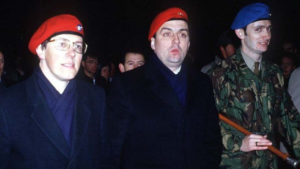
ULSTER HALL RALLY 10TH NOVEMBER 1986- PARAMILITARY CHARACTERISTIC
Journalists who arrived at Ulster Hall to report on the event were denied entry, DUP press officer Nigel Dodds instead appeared and handed out leaflets stating the goals of the new paramilitary grouping.
DUP Lord Mayor of Belfast Sammy Wilson wearing his chain of office officiated over the Ulster Resistance Rally in the Ulster Hall. Warning those in attendance not to record the event or take photos.
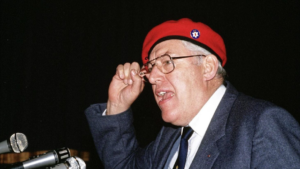
A colour party wore paramilitary uniforms and red berets
Ian Paisley told the assembled crowd that Ulster Resistance would “take whatever steps are necessary to destroy the Anglo-Irish Agreement and the ongoing republican conspiracy.”
He was then filmed dramatically placing a red beret on his head and standing to attention.
DUP deputy leader Peter Robinson was also photographed wearing the UR militant beret at the rally.
Also on the platform was Portadown Loyalist protester Alan Wright, the chairman of the Ulster Clubs who would be appointed the commander of Ulster Resistance.
Alan Wright declared the new paramilitary group would initially turn its force against the Anglo-Irish Agreement and then turn to destroy its real enemy – militant republicanism, Sinn Féin and the IRA.
Most of the political figures at the rally were members of the DUP, however, North Belfast MP, Cecil Walker, and Frazer Agnew of the Ulster Unionist Party (UUP) attended
Contrary to UUP leader James Molyneaux’s advice.
Molyneaux stated he did not object in principle to loyalist paramilitary groups assassinating members of the Provisional IRA, but added that his problem was “identifying the target”.
Walker later claimed he was unaware before the meeting that its purpose was to declare the founding of a paramilitary grouping, while Agnew stated he would not be opposed to a “citizen’s army” that came into conflict with the law. Some members of the UUP felt the new paramilitary group represented a “final straw” in the strained DUP-UUP political pact against the Anglo-Irish Agreement.
UUP MP Harold McCusker told a journalist that “there may well be circumstances” where he would consider joining Ulster Resistance.
Ulster Resistance’s first public rally was held in Kilkeel, County Down, led by a military-style colour party.
As the several thousand strong crowd marched through Kilkeel, some participants threw stones over barriers erected by the RUC in the religiously mixed town and later the visibly hostile crowd attacked a press photographer and stole his film, after the march had culminated at an Orange hall. Speaking before nine paramilitary standard bearers, Ian Paisley urged all listening to join the Ulster Resistance.
Peter Robinson told those assembled “Better to be dead than green” and “We need a body of men right across the province, prepared to die for Ulster”
At an Ulster Resistance rally in Enniskillen, County Fermanagh, Peter Robinson announced: “Thousands have already joined the movement and the task of shaping them into an effective force is continuing. The Resistance has indicated that drilling and training has already started. The officers of the nine divisions have taken up their duties.” Robinson warned at the rally that those who were “faint or half-hearted” shouldn’t bother signing up.
DUP KEY NOTE ADDRESSES – POLITICAL COVER & UNDIVIDED ATTENTION
It was reported after its launch, that Ulster Resistance was led by DUP party representatives Ian Paisley, Peter Robinson, Ivan Foster and Alan Wright, the chairman of the Ulster Clubs.
Below them were nine divisions, based on District Council areas, below them were battalions, companies and platoons.
“The military are being placed in submission to the political leadership. It must be kept under the control of elected representatives.” – Ulster Resistance Commander
In 2019 in an interview with Spotlight Ivan Foster stated Ulster Resistance Movement was “basically a DUP – Sponsored – Parented – Movement”
Alan Wright was assured during talks about establishing Ulster Resistance that the new organisation was serious about acquiring arms and “was given assurances that they were prepared to go to any lengths” to bring down the Anglo-Irish Agreement and destroy militant Republicanism.
Wright asserted that the Ulster Resistance “could carry out armed incursions into the Republic of Ireland”.
Alan Wright also spoke of the necessity of a relationship with the UDA, “I have sat with them and met with them. I have talked to them. I believe they are too big to ignore”.
The star attraction at the Ulster Resistance launch in the Ulster Hall, was DUP leader Ian Paisley, who to a roaring hall promised to protect and support the organisation, stating:
“I intend to give this movement of Ulster Resistance my undivided support. I will give whatever political cover it needs.” – Ian Paisley
ARMS IMPORTATION
Within weeks of the Rally in the Ulster Hall, the Ulster Resistance began searching for weapons.
According to RUC intelligence reports referred to in Michael Maguire’s 2019 Loughlinisland report a month after it was launched Ulster Resistance met the leadership of the UVF and UDA to discuss procuring and smuggling weapons into the North of Ireland.
The man entrusted with that task was Noel Little, from Markethill, a senior UDA and DUP member.
Noel Little had also served in the UDR from 1980 to 1986.
On 8th July 1987, the UDA, in collaboration with the UVF and UR, stole £325,000 from the Northern Bank in Portadown.
According to senior UDA figure Jackie McDonald, this raid was organised and planned by the UVF and carried out by the UDA.
Seven men carried out the raid. Three of the raiders wore RUC uniforms while the others were armed and masked. Two men were later charged, at least one of whom had UDA connections, while only one man, Kenneth McDonald, was convicted. He was traced after leaving a forged RUC warrant card containing his photograph. He claims he was paid £9,000 for his role in the raid.
This stolen money was carried to Europe, mainly to Swiss bank accounts, by ‘respectable Ulster Protestants’ involved in banking, business and insurance.
In early 1987 Noel Little travelled to Geneva and Paris to meet a representative of South African arms company, Armaments Corporation of South Africa (Armscor)
He was named as Douglas Bernhardt, an arms dealer of US nationality based in Geneva.
In his statement to French secret police, after his arrest in 1989, Bernhardt told them that Noel Little, was using the cover name Joseph Kelly presented a shopping list of weapons and explained that the Loyalists of Northern Ireland were looking for arms to defend themselves.
Jackie McDonald would go on to tell journalist Peter Taylor, “within a few months of the bank robbery being done the arms were delivered.”
The consignment arrived in Belfast in December 1987.
Douglas Bernhardt had arranged for the arms to be procured for a personal commission of £15,000.
A Lebanese arms dealer, Joseph Fawzi sourced the weapons in Lebanon and Israel.
The full consignment was brought to former RUC Reservist James Mitchell’s farm in Mountnorris County Armagh, where it was intended to be split three ways between the UDA, the UVF and Ulster Resistance.
Mitchell is widely reported to have been a Key member of the Glenanne Gang which is reported to have murder 120 people.
- THE ULSTER RESISTANCE ARMS DEAL CONSISTED OF:
- 206 Vz58 assault rifles
- 94 Browning 9mm pistols
- 6 RPG-7 rocket launchers and an estimated 62 warheads
- 450 RGD-5 Fragmentation grenades
- 30,000 rounds of assorted ammunition
ARRESTS AND CONVICTIONS
By 7th January 1988, the RUC claimed to have been made aware that a large consignment of arms intended for loyalists had arrived in the North of Ireland.
They also knew the identity of many of the senior loyalist paramilitary figures involved and witnessed a number of them meeting in Portadown that evening.
By the time that meeting took place, Person D [Noel Little] had already taken possession of the Ulster Resistance share of the consignment.
Person E [Davy Payne, UDA Brigadier of North Belfast] and persons F and G UDA members, James McCullough, a lorry driver from Bangor and Thomas Aiken, unemployed from Forthriver Park, Belfast drove the two cars which was to transport the UDA share of the UR weapons.
They were driven to a small carpark in Tandragee, County Armagh.
The two cars driven by McCullough and Aiken were hired maroon Ford Granadas, while Payne was driving an Austin Maestro.
From the carpark in Tandgragee they were led by Person C, John Jackie Whitten UVF member from Portadown, to Mitchell’s farm in Mountnorris, Whitten was driving an orange coloured Chrysler Horizon.
The RUC state that they observed the cars move south-west on the B3 road from Tangragee. They were under surveillance by RUC members of E4A but they inexplicably ‘became unsighted’ of the three cars at that point.
At Mitchells farm, they loaded the UDA’s share of the consignment into the two cars and made their way towards Portadown with Davy Payne driving ahead of them in his own car.
James Mitchell and at least six other men were present during the loading of the weapons. Shortly before midday the RUC’s, E4A allegedly picked up the scent again and noted the cars travelling north on the A27 road towards Portadown.
On the morning of 8th January the cars containing the UDA weapons were stopped at an RUC check point at Mahon Road, outside the British Army barracks in Portadown
The first car, driven by UDA Brigadier Davy Payne, did not contain any weapons. The boots of the other two cars were filled to capacity.
The second car contained: 36 Vz58 rifles and 150 grenades.
The third car contained: 25 Vz58s, 124 rifle magazines, 11,20 rounds of 7.62 ammunition and 30 Browning pistols.
A number of men, including Mitchell, had met at a house in Markethill, to discuss the arms seizure. The PONI considered it noteworthy that Person D [Noel Little] lived in Markethill.
Information was received by the RUC in 1988, that within two hours of the arrest of Payne and his associates, the remaining firearms were removed to another location in a farm vehicle. Mitchell had received a ‘tip-off’ that police intended to search his farm, so he drove the remaining weapons to a safe location in Markethill. This information was confirmed by a judgment in the High Court, Belfast on Monday 9th October 2023, which disclosed that the PSNI received information in 2016 that ‘a police officer made a phone call to James Mitchell’s farm before a police search’.
The PONI also discovered an entry in an RUC Occurrences, Reports and Complaints Book from Markethill RUC Station, dated 9th January 1988, which stated:
“4pm. Derelict house search: Between 2.10pm and 3.55pm a search team from Royal Engineers carried out a house search at Lough Road, Glenanne. These premises are owned by James Mitchell. John Mitchell (brother of James) supplied the key for the rear door. No damage was done and nothing found – key returned”.
In the weeks following the Mahon Road seizure, Persons C (John Jackie Whitten) and D (Noel Little) were arrested but denied all knowledge of the arms importation and were released without charge.
Little’s arrest appears to have been linked to his telephone number having been found written on the hand of Person E (Davy Payne).
The arrest of Person C John Jackie Whitten arose from a search of the home of Little, where documents implicating Person C were recovered
In an interview with the Guardian newspaper in October 2017, Noel Little explained to journalist Ian Cobain how his phone number was given to Davy Payne, “John McMichael had given it to him, in case he got into any trouble in Armagh,”
Part of the UVF’s share of consignment was among weapons recovered in February 1988.
An RPG-7 rocket launcher with 26 warheads, 38 assault rifles, 15 Brownings, 100 grenades and 40,000 rounds of ammunition were found following searches at a property on Flush Road area of North Belfast.
The UVF were still in control of most of its Ulster Resistance consignment.
In November 1988, part of the Ulster Resistance share of the weapons was uncovered in police searches at a number of locations in County Armagh including Markethill, Hamiltonsbown and Armagh town.
Also found in the arms dump were parts of a Javelin surface-to-air missile, several paramilitary uniforms and a number of red berets bearing the Ulster Resistance emblem with names of members of Ulster Resistance written inside.
One of those arrested and formally charged with arms possession in connection with the Markethill find was Mervyn Spratt, a long-serving DUP member from Markethill, who had contested a council election in the Cusher DEA of Armagh on three separate occasions as a DUP candidate.
The total haul at that date stood at four rifles, two pistols, 16 grenades and more than 19,000 rounds of assorted ammunition as well as a RPG-7 rocket launcher and five warheads.
Four men appeared in Court in Armagh on 17th November on arms and ammunition charges:
Former UDR member Robert Thomas Johnston (38)
Former UDR member Robert James Muldrew (21)
Former UDR member David Willis (33) and
DUP election Candidate Mervyn Spratt (41)
It was reported in the Irish Independent on 17th November 1988 that the then British Secretary of State, Tom King, said the consignment of loyalist arms found in County Armagh could have been used to launch attacks on the South of Ireland. He was commenting after the RUC had put on display the Ulster Resistance weapons which had with it a map of County Monaghan.
ESCALATION AND DEADLY IMPACT OF ULSTER RESISTANCE WEAPONS
Analysis of the six-year period surrounding the 1987 Ulster Resistance weapons consignment arriving in the North shows a stark rise in attacks and killings of nationalists and Catholics in the North.
Before UR shipment (1982-1987): 82 murders attributed to loyalist paramilitaries.
After UR shipment (January 1988- August 1994): 240 murders attributed to loyalist paramilitaries
While the UDA are reported to have lost all its share of the Ulster Resistance imported weaponry, the UVF still retains a large proportion of its share.
The first recorded use of Ulster Resistance weapons was in the attempted murder of North Belfast man Gerard Burns in March 1988 when UVF gunmen attempted to kill him. (using a VZ58 assault rifle)
In May the same year the UVF would murder three men in the Avenue Bar in Belfast City Centre. (using the VZ58 assault rifle)
The first recorded fatalities as a result of Ulster Resistance weapons was the gun and grenade attack on mourners in Milltown cemetery in March 1988. Michael Stone claims UR supplied him with weapons used in the attack.
He claims he collected these from a farm in South Derry.
The weapons used were provided to Stone by the Ulster Resistance to enable him to carry out the attack.
While the UDA relied on Ulster Resistance to supply them with weapons brought into the North by Noel Little it would not be until 1992 that they would gain possession of the Vz58 assault rifles.
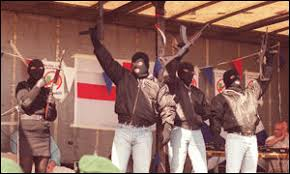
Johnny Adair claims that the UFF were provided military grade weaponry from the stock pile under the control of Ulster Resistance. As Adair put it “they were a God send,…A game changer”.
The first recorded use of the Vz58 by the UDA was in February 1992 when gunmen entered Sean Graham’s bookmakers on the Ormeau Road, killing five people.
In total, from March 1988 to August 1994, ninety-six people were murdered using weapons imported into the North of Ireland by the Ulster Resistance under the control of Noel Little.
In a newspaper interview in October 2012 with the Guardian journalist Ian Cobain, Noel Little stated – As far as he is aware, the consignment has never been decommissioned.
So, what does Noel Little really know about Ulster Resistance weapons retention?
Was Little ever questioned by the RUC or the PSNI regarding his knowledge of Ulster Resistance retaining its share of the weapons consignment?
If NOT, why NOT?
Have any former members of the DUP, who publicly supported Ulster Resistance ever been interviewed by the RUC or PSNI regarding Ulster Resistance activity?
Has any police investigation sought evidence from DUP figures publicly associated with Ulster Resistance concerning its activities?
Has Jim Allister ever publicly addressed his knowledge of Ulster Resistance?
At any time did the Irish Government raise concerns regarding the DUP’s involvement with Ulster Resistance, particularly after the comments by the then Brit SoS Tom King that Ulster Resistance weapons could be used to target the south of Ireland?
Will DUP leadership call on their MP’s and Members of the House Lords to provide whatever information they have on the activities of Ulster Resistance to the PSNI?
Will the DUP leadership call on their MP’s and Members of the House Lords to provide whatever information they have on the activities of Ulster Resistance, to the families of the 96 families who lost?